
Inspiration and advice
Timber wall panels, wood-effect and natural veneer
Timber wall panels, maintenance-free wood-effect panels on chipboard or HDF, and natural oak, walnut and birch veneer. Compare them and see the Strama Panels range.

Introduction
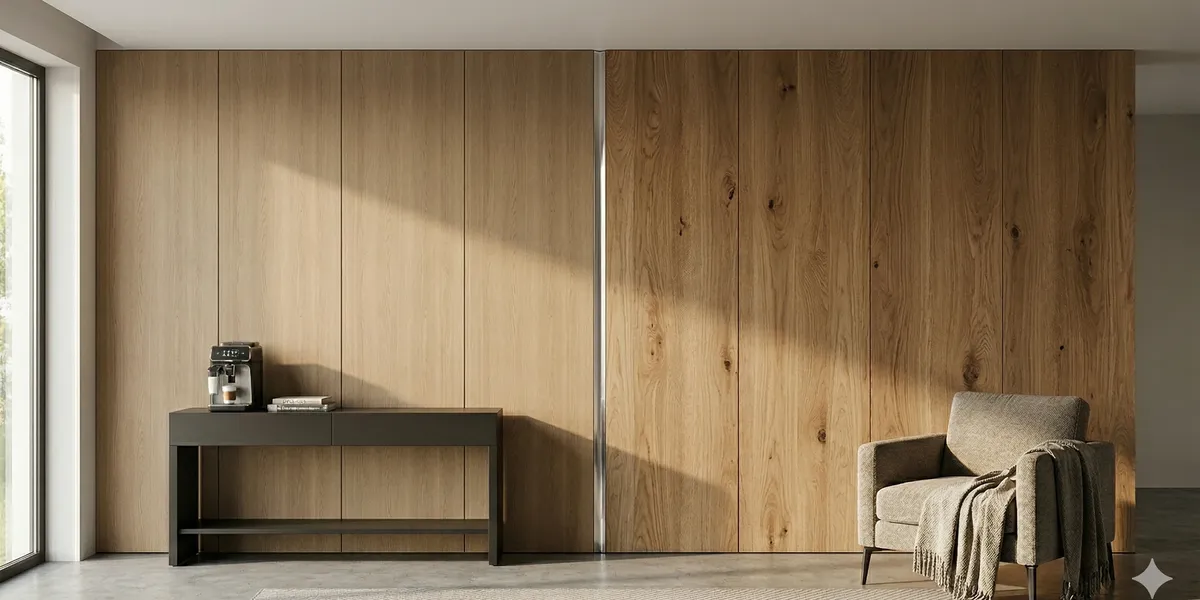
Timber wall panels are now among the most popular elements in interior design, from cosy living rooms and bedrooms to prestigious receptions and offices. The natural beauty of wood, its individual character and the warmth of its grain are beyond any other material. Strama Panels offers two types of panel with a timber effect: wood-effect Interior Design Classic, which needs no maintenance at all, and genuine natural wood veneer. This article will help you work out which version suits your interior and the way you live.
Contents
Two kinds of timber wall panel from Strama Panels
Timber wall panels in the Strama Panels range come as two separate collections, differing in material, appearance and what they ask of you in use. Both belong to the Interior Design system: they share the same dimensions (600 mm wide and 2800 mm high) and join with the same tongue-and-groove system.
Wood-effect in furniture laminate
A chipboard or HDF core with a laminate that reproduces timber. No maintenance, resistant to scratching and easy to clean. The ideal choice for heavy use. Patterns: Meloak, White Pine, Grandson Oak, Lagoda, Overland Oak, Windsor Oak, Burnt Wood.
Natural veneer (veneered plywood)
Multi-layer plywood with a top layer of real veneer. Every board has the individual character of its own grain. It can be sanded, oiled and refreshed for years.
The key difference: wood-effect wall panels are made from furniture-grade chipboard or HDF with a decorative laminate, and reproduce natural timber without its drawbacks. A veneered panel is genuine wood: you are touching a real natural timber surface, with its character, its variation and a beauty that grows with age.
Wood-effect panels, the look of timber with no upkeep
Timber wall panels in the wood-effect version are wall panels built on a chipboard or HDF core faced with a PAP or PP laminate. The laminate reproduces the structure of timber faithfully, with grain, knots and surface texture, while keeping all the advantages of a synthetic material.
The collection: patterns and finishes
Wood-effect wall panels come in a rich collection of finishes reproducing different timber species. Among the most popular patterns you will find Meloak (pale oak in a warm colouring), White Pine (Scandinavian minimalism), Grandson Oak (classic oak, a rustic style) and other finishes from the Walnut Lagoda and Overland Oak collections. That variety means wood-effect decorative panels suit any style of interior, from boho and rustic through to modern design and japandi.
Advantages of wood-effect panels
- No maintenance: no oiling, lacquering or impregnation for the whole of their life
- Scratch resistant: PAP laminate is hard and stands up to physical damage in everyday use
- Easy to keep clean: a damp cloth is enough
- Consistent pattern: every panel looks the same, which makes planning a scheme easier with no surprises
- Attractive prices: considerably cheaper than natural veneer for a similar visual effect
- For dry interiors: for a kitchen and a bathroom we recommend Bathroom Design bathroom panels with a waterproof HDF core
When to choose a wood-effect wall panel
Wood-effect wall panels answer the question of how to create an interior with the natural character of timber but none of its maintenance demands. They are the ideal answer for home offices, children's rooms, and for restaurants and hotel receptions, where heavy use rules out materials that need regular care.
Veneered panels, real wood on the wall
Natural veneered plywood is the most authentic form of timber wall panel. Multi-layer oak, walnut or birch plywood with a top layer of natural veneer gives an effect no decorative film can fully reproduce: the natural character of wood, with live grain, knots and shades that shift with the angle of the light.
Timber species available
The Strama Panels natural plywood collection covers several timber species, each with its own character:
- Oak: classic and timeless. Pronounced grain, a warm golden colouring. An oak wall panel suits modern, classic and loft-style interiors. One of the most popular choices.
- Walnut: darker, prestigious. Wavy grain creates an emphatic, dramatic image on the wall. Ideal for a study, a library or a prestigious reception.
- Birch: pale and subtle. A minimalist effect, Scandinavian naturalness. A birch panel answers the nordic and japandi trends.
- Ash, cherry, maple: available to special order. The variety of timber species lets a panel be matched to any architectural project.
Every board is one of a kind
Veneer being natural means every panel is different: the grain, knots and shades are as individual as a fingerprint. That is its greatest advantage and, at the same time, a property worth understanding before you order: the final effect of a veneered wall is always one of a kind, live and organic.
Care and durability of veneer
A veneered panel can be sanded, lacquered, oiled and refreshed, and grows more beautiful with age when cared for properly. Made from high-quality timber, our veneered panels are free of formaldehyde and emit no harmful substances, and FSC certification guarantees that the wood comes from renewable, certified forest sources. This is the choice for people who value natural materials and are ready to give their wall periodic care.
Wood-effect against natural veneer, a detailed comparison
| Feature | Wood-effect (PAP) | Natural veneer (plywood) |
|---|---|---|
| Material | Chipboard or HDF + PAP/PP laminate | Multi-layer plywood + veneer |
| Authentic timber | An imitation, a wood-effect finish | ✅ Real natural timber |
| Individuality | Consistent pattern (every panel identical) | ✅ Every board is one of a kind |
| Maintenance | ✅ None, easy to keep clean | Oiling or lacquering every few years |
| Scratch resistant | ✅ High, thanks to the PAP laminate | Depends on the finish (lacquer or oil) |
| Can be refreshed | ❌ No | ✅ Can be sanded and refreshed |
| 3D / slat effect | ✅ Available (3D slat panel) | ✅ Available to order |
| Certification | CE, E1, FSC | FSC, E1, low VOC emissions |
| Price | ✅ Lower, attractively priced | Higher, a premium material |
| Ideal for | Heavy use, kitchens, offices, hospitality | Living room, bedroom, study, premium spaces |
How to choose? If you value convenience and zero maintenance, go for wood-effect panels. If authenticity, individual character and the ability to refresh the surface matter to you, go for natural veneer. Both types share the same dimensions and the same fitting within the Strama Interior Design system.
Where to use timber wall panels: schemes and design
Timber wall panels have wide application, from private spaces to commercial ones. Here are the most popular schemes in which a timber panel changes the character of an interior completely.
Living room: a timber feature wall
A timber panel on the wall behind the sofa or behind the television is a timeless choice that will never go out of fashion. The warmth of wood contrasts with concrete floors, white walls and steel details, creating the tension between nature and modernity that defines contemporary interior design. 3D timber wall panels with a slatted structure add depth and spatial effects that change with the lighting.
Bedroom: a cosy atmosphere and better acoustics
A timber wall panel behind the bed is one of the loveliest ways to make a bedroom feel cosy. Natural veneer, or a warm wood-effect finish, turns a neutral wall into the centre of the whole room's composition. Timber wall panels also improve a room's acoustics: they reduce sound reflections and quieten the bedroom.
Study and home office
A panel in walnut or oak veneer in a study is a decorative element that builds a sense of standing and professionalism. A study with a timber wall behind the desk or beside the bookcase has a character that wallpaper and paint cannot achieve.
Reception, hotel and commercial spaces
A hotel or office reception in wood-effect panels combines good looks with practicality. Timber wall panels at attractive prices and with no maintenance demands are especially valued in commercial spaces. A timber panel behind a reception desk gives the space a warm, welcoming atmosphere and builds a positive first impression.
Fitting timber panels, what is worth knowing
Strama Panels timber wall panels are fitted in exactly the same way as every other panel in the Interior Design system. The tongue-and-groove system removes visible joints between panels, so the wall looks like a single timber surface with a fine shadow line.
Acclimatisation: an important step with natural timber
Veneered panels in natural timber need to acclimatise before fitting. Leave the panels laid out in the room for 48 to 72 hours, so the wood can adjust its moisture content to the conditions there. Skipping this step can leave the panels warped after fitting. Wood-effect panels need less: 24 hours is enough.
Fitting with adhesive or on a subframe
Timber panels are fitted just like the other panels in the system, with construction adhesive straight onto the wall or onto a timber or steel subframe. Panels can be bonded to any level, dry and primed substrate. With natural veneer we recommend mechanical fixing (screws through a subframe) rather than adhesive alone: the greater weight of plywood and its sensitivity to moisture call for a more secure fixing.
Cutting and working timber panels
Wood-effect panels are cut with a fine-toothed saw. Natural veneer can be sawn, routed and sanded, and is worked exactly like standard timber plywood. Veneer edges should be sealed with oil or lacquer after cutting, to stop them absorbing moisture from the air. Fitting veneered timber panels calls for a little more care than wood-effect panels, but the end result is exceptional.
Want to see the textures and colours of the timber panels before buying? Order samples and judge the natural beauty of the wood in your own interior.
Frequently asked questions, timber wall panels
Do wood-effect panels look like real timber?
From one or two metres away, wood-effect wall panels are indistinguishable from natural timber. The difference only shows in the touch: natural veneer has a live, slightly textured surface, while PAP laminate is smooth. If the visual effect is the priority, attractively priced wood-effect panels are an excellent choice. If touch and authenticity matter to you, choose veneer.
Which timber species are available in Strama veneered panels?
The standard collection covers oak, walnut and birch. Ash, cherry, maple and other species are available to order. Every species can be finished with oil (which brings out its naturalness), or with matt or gloss lacquer. Contact us to find out about the availability of a particular species and the right panels for your project.
Can timber panels be used in a kitchen or a bathroom?
Wood-effect panels on chipboard are intended for dry interiors. For a kitchen and a bathroom we recommend Bathroom Design bathroom panels with a waterproof HDF core and waterproof facing foil. Natural veneer is not intended for rooms with high humidity, as it can warp and discolour with prolonged contact with steam.
Do timber wall panels improve the acoustics?
Yes. Timber wall panels absorb some of the sound energy and reduce reverberation in a room. The acoustic effect is more pronounced with natural veneer (a thicker material) than with the thin laminates of wood-effect panels, but both types genuinely improve acoustic comfort compared with a smooth, hard wall.
How do I care for wood-effect wall panels?
Wood-effect panels are easy to keep clean: a damp cloth and a mild detergent are enough. Avoid abrasives and excess water. They need no oiling or lacquering. Natural veneer should be wiped over with oil or wax every few years, which protects the wood from drying out and keeps its natural sheen.
Can wood-effect panels and natural veneer be combined on one wall?
Yes. Both types share identical 600 mm dimensions and the same tongue-and-groove system. You could create a wall combining, say, an oak veneer panel with a wood-effect slat panel in the same finish, where the individual character of the veneer complements the regular rhythm of the slats. Talk the choice of panels through with us before ordering.
How much do Strama timber wall panels cost?
Wood-effect panels are attractively priced, from around PLN 200 for a 600 × 2800 mm panel. Natural veneer panels cost more, because of the quality of the material and the labour involved. Contact us for a quotation for a particular project, or check current prices in the online shop.
In summary, timber wall panels for any room and any budget
Strama Panels timber wall panels are two different products for two different needs. Wood-effect panels on chipboard or HDF are for anyone who wants the look of timber with no maintenance at all and at an attractive price. Natural veneer is for anyone who values authenticity, the individual character of every board and natural materials that can be refreshed for years. What both versions share is the same fitting system, the same dimensions and Strama Panels' Polish production.
See the timber wall panel collection and order finish samples:
→ Wood-effect and veneered panels: the Strama Panels shop


