
Inspiration and advice
Living room wall panels, which to choose and how to fit them
Living room wall panels, MDF, fluted, slatted and 3D. See which decorative panel suits your room and how to fit it yourself.

Introduction
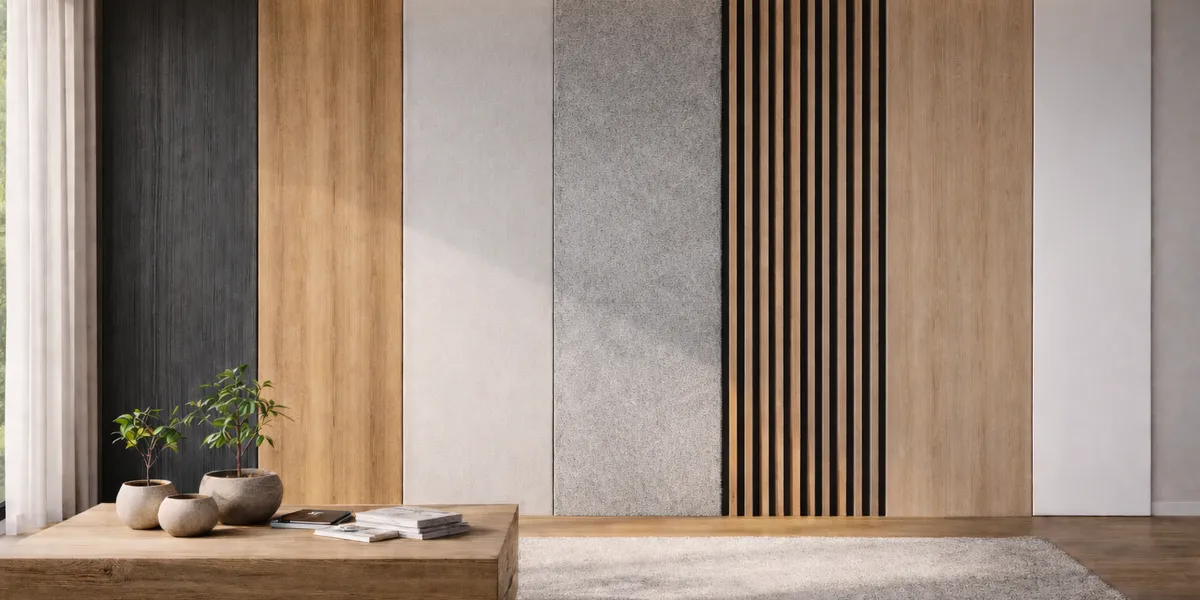
A wall panel is one of the quickest and most striking design tools you can bring into a living room. A single wall covered in well-chosen decorative wall panels can change the character of the whole room, with no major building work and no week spent waiting for plaster to dry. This guide will help you work out which type of panel suits your interior, how fitting works and what to look at when choosing.
Contents
Types of wall panel for a living room, an overview
Decorative wall panels are now one of the most popular ways of finishing walls in living rooms, dining rooms and open-plan spaces. With a wide range of patterns, textures and materials, you will find panels that suit a minimalist white living room just as well as an industrial loft in concrete. Below is an overview of the main types.
Wall panels: a classic with wide scope
Wall panels are the most popular choice for a living room. Furniture-grade chipboard faced with a decorative laminate is light, stable and scratch-resistant. Choosing wall panels gives you a wide range of wall panels in dozens of finishes, from timber through architectural concrete to solid matt colours. A wall panel is the ideal answer for anyone who wants a striking result on a limited budget and timescale.
Slat panels: lightness and natural materials
Slat panels are a system of narrow battens (slats) fitted onto a shared backing or straight onto the wall. A slat can be made of MDF, solid timber or veneer, and each version gives a different visual effect. Slat panels are especially popular in Scandinavian and japandi schemes, where natural materials and a clean texture are valued.
3D wall panels: striking geometry on a feature wall
A 3D wall panel creates a three-dimensional texture on the wall that shifts with the light falling across the surface. Modern 3D wall panels come in geometric, organic and abstract versions. A 3D wall panel is the ideal answer for a feature wall in a living room: one panel can completely change how a room reads. Modern 3d wall panels call for precise fitting, but the end result is exceptional.
Upholstered panels: elegance and acoustic performance
Upholstered panels and acoustic panels are for people who value sound comfort and a luxurious look at the same time. Upholstery fabrics absorb sound and reduce reverberation in a large living room. Upholstered wall panels work well in a living room with hard floors and a high ceiling, where acoustic comfort matters.
Concrete panels and panels reproducing natural materials
Concrete panels and panels reproducing natural stone are for anyone building an industrial or loft-style interior. A wall panel in a concrete or stone texture gives a raw, emphatic effect without the drawbacks of wet trades. Wall panels in a concrete finish can reproduce both smooth and board-marked concrete, with dozens of texture and colour variants to choose from.
| Panel type | Material | Living-room style | What sets it apart |
|---|---|---|---|
| Classic MDF | MDF board + laminate | Any | Wide range of wall panels, scratch-resistant |
| Fluted wall panels | MDF / timber | Modern, minimalist | Depth, play of light and shade |
| Slat panels | MDF / veneer / timber | Scandinavian, japandi | Natural texture, lightness |
| 3D wall panel | MDF / plaster / PVC | Avant-garde, loft | Three-dimensional, one-off effect |
| Upholstered panels | Foam + fabric | Glamour, classic | Acoustic performance plus elegance |
| Concrete / stone | MDF / polyurethane | Industrial, loft | Reproduces natural materials without their drawbacks |
How to choose wall panels for a living room: what to weigh up
When choosing wall panels for a living room, it is worth checking a few key points before you place an order. Choosing wall panels is a decision that should take account of the style of the interior, the conditions they will live in and your budget.
Style and colour: matching the rest of the living room
Decorative wall panels for a living room should be consistent with the existing floor, furniture and lighting. White panels make a space feel larger and are a classic choice for pale living rooms. Dark timber or concrete finishes warm an interior and make it feel cosy in the evening. When choosing wall panels, start from the colour that dominates the living room and pick a panel that either completes it or contrasts with it.
With the wide range of patterns and colours in the Strama Panels range, you will find panels to suit any interior, from classic beige and timber to modern shades of graphite and textured white.
Room size and wall height
Choosing wall panels should take the proportions of the living room into account. In small rooms, vertical wall panels make the ceiling appear higher. In a large space, horizontal slat boards lengthen the wall and create a sense of width. With ceilings above 2.7 m, tall floor-to-ceiling panels work well and make a striking architectural statement.
Performance: moisture, sound, durability
Wall panels in a living room near a fireplace or a kitchen should resist moisture and higher temperatures. For a bathroom and for a wall next to a kitchen, we have our Bathroom Design bathroom panels with a waterproof HDF core and waterproof facing foil, click-together STRAMA CLICK joint, grout-free. If the living room adjoins a child's room or is used for watching films, consider acoustic panels or upholstered panels, whose acoustic performance genuinely improves sound comfort in the space.
Samples beat personal preference
Before you decide, order finish samples. Something that looks perfect on screen may have a different texture or shade in reality. Matching the panel to the particular light in your living room (daytime against evening) is the step that will save you disappointment after delivery.
Tip: the wall panels available from Strama Panels can be ordered as samples before purchase. Check the texture and colour in your own living room before you commit to a whole wall.
Wall panel schemes, ideas for a living room
Wall panels can be used in many ways. Here are the living-room schemes most often chosen by clients and designers.
The wall behind the sofa: the classic feature wall
The wall behind the sofa is the part of a living room that draws the eye most. Decorative wall panels for a living room on this wall become the natural centre of the whole composition. Modern decorative panels in a timber or concrete finish, or elegant slat panels, all work perfectly as a backdrop behind a sofa.
The wall behind the television: modern media joinery
A wall panel behind the television does two jobs at once, decorative and practical. Decorative wall panels behind a TV conceal cables, create a uniform backdrop for the screen and give the media zone a coherent look. White panels, or panels in a dark colour, look particularly good with a dark television and concealed LED lighting behind the panel.
Full floor-to-ceiling wall treatment
Wall panels are easy to fit across an entire wall, creating a coherent, architectural treatment from floor to ceiling. This works especially well in a living room with high ceilings, where full coverage gives the room character and elegance. Wall panels for a living room in this version need precise cutting at ceiling and floor; a trim or a starter system conceals the ends.
A narrow band as a decorative element
You do not always have to cover a whole wall. A narrow band of decorative wall panels at a height of, say, 90 to 120 cm from the floor makes a striking stripe that echoes classic wainscoting. It suits people who want a subtle finish without a dominant visual effect.
How to fit wall panels in a living room, step by step
Wall panels are the ideal answer for anyone who does their own work: fitting panels needs no specialist tools and no great building experience. Wall panels are easy to fit yourself within a single working day.
Step 1: preparing the wall
The wall must be dry, level and sound.
Step 2: measuring and cutting the panels
Measure the whole surface to be covered accurately and work out how many panels you need, adding 10% for waste. Panels are cut with a fine-toothed circular saw or a jigsaw. Angled cuts (at slopes or recesses) call for a bevel gauge or a test cut on an offcut.
Step 3: direct fitting or fitting to battens
Light wall panels are fitted straight onto the wall with polyurethane construction adhesive, which is the simplest and quickest method. Where walls are uneven, or where electrical services need concealing, a batten frame is used. Panels can be fitted to battens with screws, with each panel clipping into the previous one so that no fixings are visible.
Step 4: finishing with trims
Starter, corner and end trims complete the scheme and conceal the panel edges at floor, ceiling and corners. The trim must come from the same system as the panel, which guarantees a precise fit and a uniform finish. Without trims, even carefully laid panels look unfinished.
Want to see how the panels look in the flesh? Order finish samples and check the texture in your own living room before you buy.
Looking after wall panels, durability and easy upkeep
Wall panels are a long-term answer: cared for properly, they keep their looks for a decade or several. Their usefulness does not stop at appearance, either: they are easy to keep clean.
Everyday cleaning
Wall panels and slat panels are cleaned with a damp cloth and a mild detergent. Avoid abrasive and chemically aggressive products, which can damage the facing. Clean upholstered panels with an upholstery brush or a vacuum cleaner with a fabric attachment.
Resistance to physical damage
Wall panels resist scratching under normal use. Where use is heavy (a hallway with children, say), it is worth choosing the variant with a harder-wearing film (vinyl). Damage from a heavy impact can be hard to repair without replacing the panel, and this is the point at which panels lose out to plaster, which can be filled locally.
Resistance to moisture
Standard wall panels are intended for dry interiors. For a wall next to a kitchen, in a bathroom and wherever there is water and steam, choose Bathroom Design bathroom panels. They have a waterproof HDF core and waterproof facing foil, and the STRAMA CLICK click joint leaves no grout lines for dirt and moisture to collect in.
Frequently asked questions, living room wall panels
That depends on the style of the interior and on personal preference. If you are choosing wall panels for a modern living room, look at fluted wall panels or slat panels. For classic and glamour interiors we recommend upholstered panels. For an industrial style, concrete panels. MDF wall panels in timber finishes work in any style.
The cost depends on the panel chosen, the wall area and any fitting charges. Lightweight wall panels from Strama Panels are one of the more attractively priced answers on the market. Ask us for a quotation.
Yes. Wall panels are easy to fit yourself using basic tools. Doing one wall (around 10 to 12 m²) usually takes 3 to 5 hours the first time. Step-by-step fitting instructions come with every order.
Yes. Decorative wall panels are a durable, hard-wearing answer: fitted correctly, they last a decade or more with no need for refurbishment. Decorative laminates resist fading in sunlight and are easy to keep clean.
Yes. For a bathroom we recommend Bathroom Design bathroom panels: waterproof HDF core, waterproof facing foil and click-together STRAMA CLICK joint, grout-free.
Choosing wall panels for a living room and a bedroom within one system is a good idea, as it keeps the whole home visually coherent. Wall panels for a bedroom should be warmer in texture and colour than those in a living room. Choosing wall panels in the same finish is an elegant way to unify the style while keeping the individual character of each room. Wall panels can also be used in a hallway and on a ceiling.
In summary, wall panels are a sound answer for a living room
Wall panels bring together quick fitting, a wide choice of patterns and durability in a single product. Decorative wall panels for a living room, whether classic, slatted, 3D or upholstered, let you transform a living-room wall in one weekend, with no major building work. Choosing wall panels from the Strama Panels range gives you an adviser to work with, samples before purchase and the quality guarantee of a Polish manufacturer.
See the full wall panel range and choose your finish: → Wall panels: the Strama Panels range


